Nitrogen Precharge: A Reliability Routine for Hydraulic Accumulators
Photo: Luigi Antonio Pezone, CC BY 4.0, via Wikimedia Commons
Accumulators are among the most useful components in a hydraulic system and among the easiest to neglect. Once installed, a bladder or diaphragm accumulator can sit for years with no obvious external sign that its nitrogen precharge has drifted. The oil side still pressurises, the machine still moves, and the maintenance team has no immediate reason to look further. That is precisely why precharge deserves a place in the planned maintenance routine rather than a footnote in the commissioning file.
Why precharge drifts without an obvious leak
Nitrogen precharge is not a fixed quantity. Bladder and diaphragm materials allow a small amount of gas permeation over time, particularly at higher operating temperatures. Charging valve cores and seating surfaces can weep slowly. Poor commissioning practice, such as charging to the wrong pressure or using an uncalibrated gauge, can leave a machine wrong from day one. Temperature also matters: a reading taken in a cold plant room is not directly comparable with one taken after a warm shift, and a team that does not record conditions can chase shadows.
On UK sites, the combination of damp conditions, seasonal temperature swings and intermittent operation can make the drift less predictable. An accumulator that is correct in July may be noticeably low by January. The change is rarely dramatic in a single week, which is why it escapes attention. It becomes visible only when the system starts to behave badly and someone begins to question the accumulator.
What poor precharge costs
A low precharge reduces the usable gas volume and changes the accumulator's ability to absorb pulsation or supply flow during demand peaks. The immediate effect is often a slower response, a harsher pressure spike or more frequent pump loading and unloading. In a system that relies on stored energy for fast movement, the machine may feel lazy or inconsistent. In a pulsation-damping application, pipework and components may be exposed to greater pressure variation than the designer intended.
There is also a pump-life argument. If the accumulator no longer supports the system as expected, the pump may cycle more often, run closer to its pressure limit or experience more abrupt loading. That translates into heat, energy loss and wear. The irony is that a nitrogen top-up is a relatively modest task, while the consequences of ignoring it are paid for in pump hours, valve wear and production interruptions.
A safe precharge check routine
Accumulators store energy, so the routine must begin with safety rather than with a gauge. Work should be planned under the Pressure Systems Safety Regulations 2000 and the site's own permit and isolation arrangements. Only competent personnel should adjust precharge, and nitrogen should be used exclusively. Oxygen, compressed air or any other gas must never be substituted.
A practical sequence is as follows:
- Identify the accumulator from the asset register and confirm its type, size and specified precharge. Check whether the specification is stated at a particular temperature.
- Isolate the hydraulic side and relieve oil pressure fully. Confirm zero pressure at a suitable test point and apply lock-off. Precharge is checked with the oil side depressurised.
- Inspect the charging valve and surrounding area. Look for damaged caps, corrosion, oil weeping or a missing valve core. Fit the charging kit only with the correct adaptor and a hose in good condition.
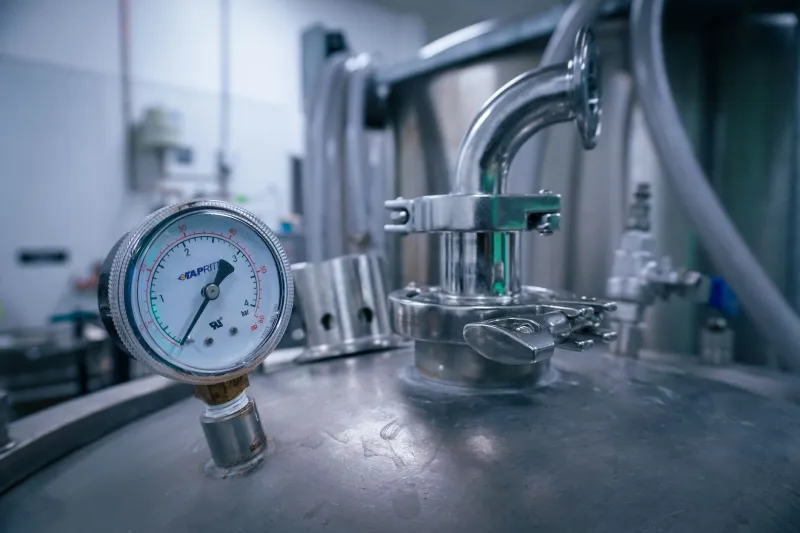
- Measure the static nitrogen pressure with the oil side at zero. Use a gauge of appropriate range; a large-range gauge will not resolve small but meaningful drift.
- Compare the reading with the specification and with previous records. If adjustment is needed, charge slowly through a nitrogen regulator. If the pressure is high, bleed it carefully through the approved kit, not by loosening a connection.
- Leak-test the valve after charging, refit the protective cap and record the result. Restore the oil side, remove lock-off and observe the system through a normal cycle.
Common mistakes with nitrogen charging kits
Many problems start with the kit rather than the accumulator. A gauge with a 0 to 400 bar range may be fine for a high-pressure system but poor for resolving a 5 bar drift on a low-pressure accumulator. Dirty adaptors can depress the valve core incorrectly or allow a slow leak after the job is finished. Over-tightening the connection damages seating faces. Purge steps are sometimes skipped, allowing air into the charging hose and producing a misleading reading.
A frequent error is checking precharge with oil pressure still present. The gauge then shows a combination of gas and system pressure, and the technician may conclude that the accumulator is healthy when it is not. Another is charging to the nominal figure without considering temperature or the manufacturer's instructions. Finally, some teams adjust precharge without recording the starting pressure, making it impossible to see whether the accumulator is stable or steadily losing gas.
Record keeping that earns its keep
A simple record is more valuable than a perfect procedure that is never repeated. For each accumulator, log the asset identifier, type, size, specified precharge, measured precharge, oil-side temperature, ambient temperature, date, technician, nitrogen cylinder pressure and any action taken. Add the next due date and a note of any trend. A paper tag on the accumulator plus a digital entry in the maintenance system is often enough.
The trend is the real reliability signal. One low reading may be a gauge error or a cold day. Three successive readings showing a slow decline point to a charging valve or bladder issue that should be investigated. Teams can then set intervals by criticality rather than by habit: quarterly for critical accumulators, longer for low-demand units, with an immediate check after any bladder, diaphragm or valve work.
Precharge is not a glamorous maintenance task, but it is a measurable one. A disciplined check protects response times, reduces unnecessary pump cycling and gives maintenance teams evidence that the accumulator is doing its job. In energy and reliability terms, that is a modest routine with a disproportionate return.