Finding the Hiss in the System: A One-Week Compressed-Air Leak Audit

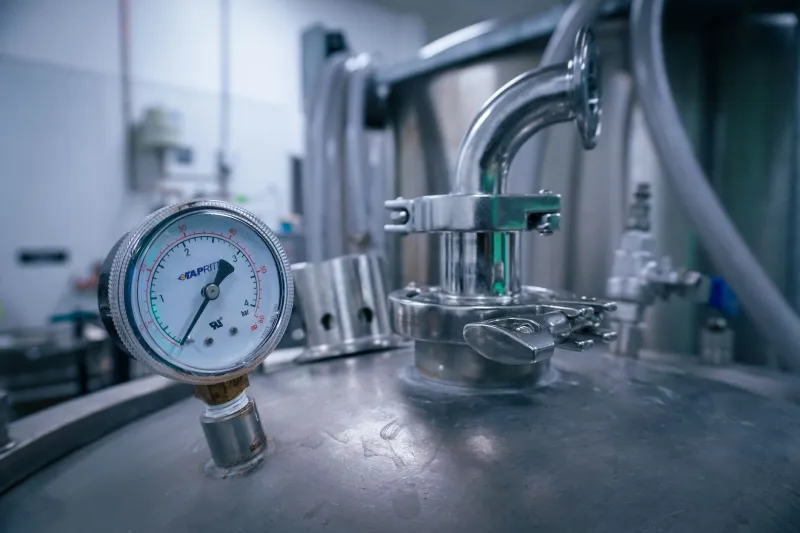
Photo: ultrasonic leak detection compressed air industrial plant maintenance, via www.cardcow.com
Compressed air is one of the most expensive utilities on a UK industrial site, yet it is often treated as free at the point of use. A leaking coupling in a quiet corner can run continuously for a year, and the energy is paid for whether the production line is busy or idle. The good news is that a focused one-week audit can find most of the significant leaks, quantify them and build a repair list that management can act on.
This is a practical sequence for a maintenance team. It does not require a full energy survey or a plant shutdown. It requires a detector, a map, some tags and a consistent way of recording what is found.
Why a 1 mm leak matters
A 1 mm equivalent hole at around 6 to 7 bar can pass roughly 0.8 litres per second of free air, depending on the orifice and pressure. Over a year of continuous operation, that is in the region of 2,500 to 3,000 kWh of compressor energy. At UK industrial electricity prices in 2026, assuming something like 25 to 30 p per kWh, the annual cost is commonly in the range of £600 to £900 for that single leak. A 3 mm leak can be an order of magnitude worse.
The exact figure will vary with pressure, compressor efficiency and load profile. The point is not to argue over a few per cent. It is to show that small leaks are not small costs. A £20 push-in fitting or a few minutes with a spanner can pay back in weeks.
Day 1: baseline and map
Start with the compressor room. Record run hours, pressure bands, kWh meter readings and any existing leak reports. If the site has a building management system or a compressor controller, export a week of data if possible. Note the system pressure and whether the site runs at a fixed or variable pressure profile.
Walk the distribution system with a simple map. Mark isolation valves, dead legs, unused drops, condensate traps, filters, regulators and lubricators. Identify high-risk areas: quick-release couplings, flexible hoses, cylinder rod seals, solenoid valve exhausts, open blow-offs and equipment that has been disconnected but not capped. Give each area an ID so that tags and repair records match.
Day 2 and 3: ultrasonic survey
An ultrasonic leak detector is the most efficient tool for a live survey. It responds to the high-frequency sound produced by turbulent flow through a small orifice, which is often inaudible to the human ear in a noisy plant. Use a directional probe and scan methodically: joints, threads, hose crimps, valve bodies, filter bowls, regulator diaphragms and condensate drain paths.
Survey during a production lull or a planned stop if possible. If the plant must run, take care around moving machinery, hot surfaces and electrical equipment. Do not use soap solution on live electrical components or in areas where the liquid could create a slip hazard. Use the detector first, then confirm with soap only where it is safe and practical.
Tag every confirmed leak with a unique number and record the location, the component, the estimated leak size and a photograph. A detector that gives a decibel reading is useful for prioritisation, but the tag and description matter more for the repair team.
Day 4: isolation testing
Ultrasonic surveys find leaks that are accessible and audible to the instrument. Isolation testing finds the ones hidden in pipework, buried runs or equipment that cannot be reached while running. Close sectional valves and monitor pressure decay on the isolated section. A section that loses pressure with no legitimate demand has a leak.
This needs care. Confirm that isolation will not affect safety-critical equipment or production. Use a non-production window and work to a written procedure. Record the start pressure, the end pressure, the time and the section volume if known. Compare sections to rank the worst offenders. Isolation testing is also useful for proving a repair: if the section now holds pressure, the leak has been addressed.
Day 5: repair triage
Not every leak can be fixed in the same week. Triage by payback and criticality. Quick wins include tightening or replacing push-in fittings, replacing cracked hoses, fitting new seals to filter bowls, replacing damaged condensate trap valves and capping unused outlets. Use the correct thread sealant for the application and avoid over-tightening tapered fittings, which can crack components and create a larger leak.
For each repair, record the parts cost and labour time. A leak that costs £700 a year and takes half an hour to fix is an obvious priority. A leak on a high-level pipe run may need scaffolding or a shutdown, so it belongs in the planned maintenance list. The aim is to build a ranked list, not to chase every hiss on the first day.
Day 6: verify and quantify
Re-scan the repaired items. A repair that has not been verified is only a hope. Update the tag status and record the new reading. Calculate the annual saving using the estimated leak flow, the operating hours and the compressor specific power. If the site does not have a measured specific power, use a conservative figure from the compressor manufacturer and state the assumption.
Payback is simple: repair cost divided by annual saving. Use it to support the business case for the next round of repairs. Group small leaks into a campaign if individual paybacks are modest; the cumulative saving is often more persuasive than a single large repair.
Day 7: report and embed
Write a short report for management. Include the number of leaks found, the estimated annual cost, the repairs completed and the remaining prioritised list. Convert the energy saving into kWh and carbon dioxide equivalent using the current UK Government conversion factors if the site reports under SECR, ESOS or an ISO 50001 programme. That links the maintenance work to the site energy-reduction reporting that already has management attention.
Then embed the routine. Add leak tags to the CMMS, set a monthly or quarterly re-survey, and train operators to report new leaks rather than live with them. A one-week audit is a strong start, but the saving comes from making leak detection a normal part of plant care.