Before the 2026 Heatwave: A Cooler Margin Audit for Hydraulic Power Units

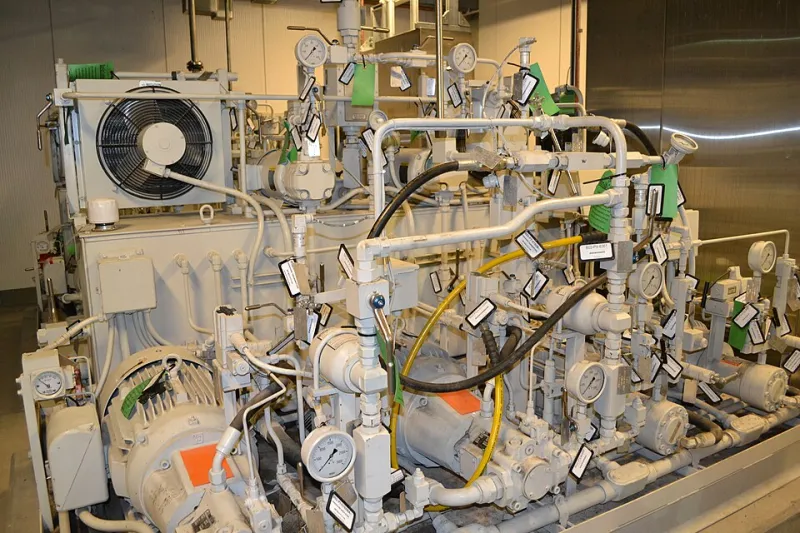
Photo: Derek Harper , CC BY-SA 2.0, via Wikimedia Commons
UK hydraulic power units are usually designed around temperate ambient conditions. That assumption is becoming less reliable. A unit that held oil temperature comfortably in a mild summer can run close to alarm during a sustained heatwave, and the first sign is often a production stop rather than a gradual warning. A cooler margin audit before the 2026 summer season is a practical way to find the constraint while there is still time to clean, adjust or plan a repair.
Cooler capacity is not the same as cooler margin
A cooler can be technically capable and still have almost no margin. Fouled fins, restricted water flow, recirculating hot air, a tired fan motor or an alarm set too close to normal operating temperature will all reduce the useful margin. Margin is the difference between the oil temperature the unit reaches under normal duty and the temperature at which the control system alarms or derates. If that difference is small, the next hot spell will expose it.
Start by reviewing trend data or, where none exists, by taking a baseline set of readings on a normal production day. Record ambient temperature, oil temperature at the tank, oil temperature at the cooler inlet and outlet, fan current or water flow, and any alarm history. That baseline is the reference for every subsequent check.
Air-blast coolers: airflow first
For air-blast coolers, airflow is the first thing to verify. Confirm that the fan is running in the correct direction and at the correct speed. Check the fan blades, coupling and motor current. A fan that is turning but moving less air than expected can be easy to miss. Inspect the fins for dust, pollen, fluff and oil mist. UK plants often accumulate airborne debris through spring, and a partially blocked core can lose a surprising amount of heat rejection.
Clean the core in accordance with the manufacturer instructions. Avoid bending the fins or driving contamination deeper into the core. Check for ducting leaks, missing panels and recirculation, where hot discharge air is drawn back into the cooler inlet. Measure the air temperature rise across the cooler if an anemometer or temperature probe is available. A low air-side temperature rise can indicate reduced airflow or a cooler that is already doing little useful work.
Also check any thermal bypass valve. A bypass that is stuck partly open will send hot oil around the cooler, and the fault may only become obvious when ambient temperature rises.
Water-cooled coolers: fouling and water-side flow
Water-cooled coolers need both sides checked. On the water side, confirm flow, inlet and outlet temperature, pressure drop and strainer condition. Hard water areas can scale a plate or shell-and-tube cooler gradually, and the loss of performance is often attributed to the hydraulic system rather than the cooler. Check for fouling, debris and biological growth. Verify that isolation valves are fully open and that any control valve is modulating correctly.
On the oil side, look for sludge, varnish or restricted flow. A cooler that is clean on the water side but partly blocked on the oil side will still run hot. Where a glycol mixture is used, confirm the concentration and condition. Do not assume that a cooler is healthy because the water feels cold; the heat has to pass through both surfaces.
Temperature alarms and control settings
Review the oil temperature alarm and trip settings against the oil supplier and OEM recommendations. An alarm set too high gives the maintenance team little time to react; an alarm set too close to normal running temperature creates nuisance trips. The right setting depends on the system, but the principle is that the alarm should provide useful warning before damage or production loss.
Test the alarm and the sensor. A sensor that reads low will delay the warning, and a sensor that reads high will cause unnecessary shutdowns. Check fan staging and control hysteresis. If the cooling fan runs continuously in mild weather, that may be a sign that the control setting or the cooler condition is already marginal. Trend the oil temperature against ambient temperature; a rising trend at the same ambient is more informative than a single reading.
Reservoir ventilation: the overlooked constraint
Reservoir ventilation is easy to overlook because it does not look like part of the cooling system. A tank breather that is clogged or undersized can pressurise the reservoir, disturb return flow and contribute to aeration and foaming. Foam carries less heat away and can reduce the effective cooling of the oil. Check the breather or filter condition, the air path and the tank headspace. Confirm that the oil level allows for thermal expansion without overfilling.
In hot weather, oil expands. A tank that is filled to the top when cold may have little room for expansion when hot. That can force oil out through seals or breathers and leave the system with less oil than expected. Check the sight glass or level indicator at operating temperature, not only when the unit is cold.
A pre-summer audit in one shift
- Record ambient, tank oil temperature and cooler inlet and outlet temperatures.
- Check air-blast fan direction, speed, current and airflow.
- Clean or inspect cooler fins, ducts and recirculation paths.
- Check water flow, strainers, pressure drop and water-side fouling.
- Review alarm and trip settings, then test the sensor and alarm.
- Inspect the reservoir breather, oil level and expansion space.
- Compare results with the previous baseline and record the findings.
Acting on the findings
If normal summer oil temperature is within 5 °C of the alarm setting, the cooling system has insufficient margin and should not be left until the next heatwave. Clean the cooler, restore airflow or water flow, correct the alarm setting or plan a repair. The work is not only a reliability measure. A cooler that is fouled or a fan that runs longer than necessary consumes energy, and restoring heat rejection can reduce fan run time and improve hydraulic efficiency.
The aim of the audit is to find the constraint before a hot week finds it for you. A recorded baseline, a clean cooler and a sensible alarm setting give UK maintenance teams a far better chance of keeping hydraulic power units within their thermal margin through the 2026 summer.