Particle Counts, Not Top-Up Volumes: Reading ISO 4406 in Damp UK Plants

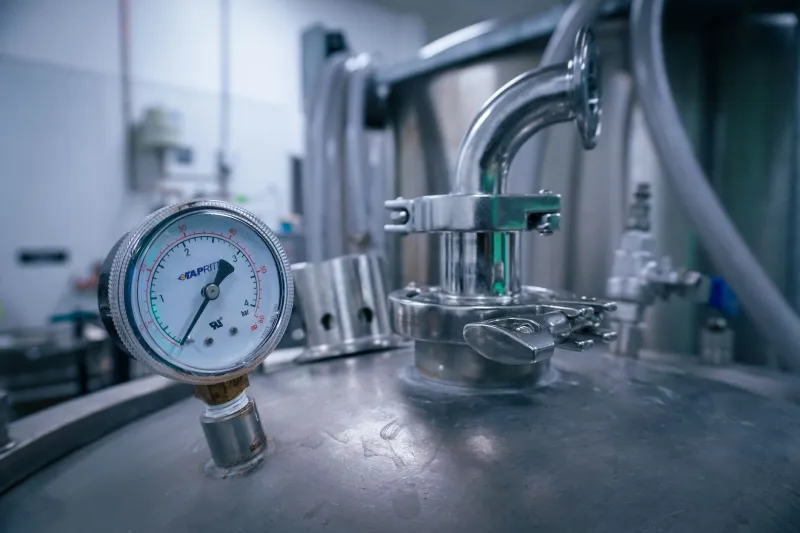
Photo: hydraulic oil sampling valve reservoir industrial maintenance engineer, via imgv2-2-f.scribdassets.com
Topping up a hydraulic reservoir is often treated as routine housekeeping. The level sight glass is low, a drum is opened, and the system is brought back to the mark. The machine may run, but the oil condition has not been restored. In many UK plants, particularly those with cold stores, washdown areas or outdoor plant, the more useful question is not how much oil was added but what the ISO 4406 code is doing between top-ups.
ISO 4406 is a cleanliness code, not a quality certificate. It reports particle counts in three size bands and gives maintenance teams a compact way to trend contamination. Used properly, it exposes the wear and ingress that a top-up can obscure.
What the three numbers actually mean
The current ISO 4406 code uses counts of particles larger than 4 µm(c), 6 µm(c) and 14 µm(c). The (c) matters: it refers to calibration to ISO 11171, which is the method used for automatic particle counters in hydraulic service. A code such as 18/16/13 is read in that order. Each step represents a doubling of the particle count, so a move from 16 to 18 is not a small drift; it is a fourfold increase in the relevant band.
The code is not a pass or fail mark on its own. A servo valve, a high-pressure piston pump and a robust gear pump do not need the same target. OEM manuals and component suppliers should set the target, and the target should be tied to the most sensitive component downstream. A clean reservoir with a dirty branch is still a dirty system.
Particle counting also says little about water. A sample can show an acceptable ISO code while carrying dissolved or free water that is attacking additives and causing corrosion. In damp UK sites, particle trend and water trend should be read together.
Why topping up can look reassuring
A top-up changes the volume, not necessarily the contamination level. It may dilute a concentration, but it also introduces fresh opportunities for ingress: the drum top, the funnel, the transfer pump, the open filler neck and the breather that was disturbed while the cap was off. If the oil is stored in a cold, humid corner, the drum itself can act as a breathing vessel, drawing moist air in as temperatures fall and pushing it out as they rise.
There is also a filter effect that can mislead. A return filter may capture particles while the machine is running, but cold oil can open a bypass valve, and a loaded filter may pass more than its rating suggests. Filter ratings need to be read carefully. A nominal rating is not the same as an absolute rating, and a beta ratio such as β200(c) = 200 describes performance at a stated particle size. A filter that is efficient at 10 µm(c) may be unremarkable at 4 µm(c). Matching the filter to the target code is more useful than choosing the lowest nominal micron number on the shelf.
The damp, cold workshop problem
UK maintenance teams often deal with conditions that are not represented in a clean laboratory example. Mobile plant comes in wet and cold. Indoor machines sit in unheated bays over winter. Washdown equipment pulls moist air into reservoirs as they cool. Outdoor installations can have breathers that are damaged, missing or simply unsuitable for the environment.
Condensation in the reservoir headspace is a common route for water ingress. As the oil and air above it cool, moisture can condense on the reservoir walls and run back into the oil. Desiccant breathers help, but only if they are sized correctly, checked regularly and replaced before the colour change is complete. Particulate breathers protect against dust but do not remove moisture. A machine that is washed down weekly may need a different breather strategy from one in a dry assembly hall.
Cold oil adds a second problem. Viscosity rises, pressure drop across filters increases and the system may spend longer in bypass. Particles that would otherwise be captured can circulate. Starting a cold machine and immediately loading it is a poor combination. Where possible, allow a warm-up period and check that the filter indicator is not showing bypass.
A troubleshooting walkthrough
Consider a typical complaint: the ISO code on a pump set has crept from 17/15/12 to 19/17/14 over several months, and the maintenance team has been topping up regularly. The machine is in an unheated bay and runs outdoors on some shifts.
Start with the sample, not the oil. Confirm that the sample point is a live, turbulent point and that the bottle was clean. A sample taken from the top of the reservoir, or from a slow dribble at a drain, may not represent the circulating oil. Check that the sample was taken at a consistent machine condition and temperature.
Next, compare top-up records with sample dates. A rising code after a period of frequent top-ups suggests the top-up is part of the problem, not the cure. Inspect the filler neck, cap seal and breather. Look for signs of moisture in the headspace, rust on the underside of the cap or a desiccant breather that has changed colour.
Check the filter differential indicator and the bypass history. If the filter is loading quickly, the system may be generating particles or ingesting them faster than the filter can remove them. Look at the return filter, the pressure filter and any offline filtration. Confirm that the correct element is fitted and that it has not been substituted for a lower-rated element during a breakdown.
Then inspect storage and transfer. Are drums kept under cover with the bung tight? Is the transfer container clean and capped? Is the same funnel used for hydraulic oil and for coolant? These small details are common sources of contamination in busy workshops.
Finally, clean the system and re-sample. A single sample after a top-up is not a trend. Take a sample after the machine has run under normal load, then repeat at a fixed interval. If the code falls and stays down, the ingress route has probably been addressed. If it climbs again, look for a persistent source: a damaged breather, a worn cylinder wiper, a leaking heat exchanger or a washdown jet reaching the reservoir.
A simple sampling routine without a full contract
A full oil-analysis programme is valuable, but a maintenance team can build a useful routine without committing to a comprehensive contract. The essentials are consistency and record-keeping.
Use clean sample bottles and a dedicated sampling valve where possible. Sample from the same point, at the same machine condition, after the oil has circulated. Record machine hours, oil top-up volume, filter changes and any repair work. Send the sample to a laboratory for ISO 4406 particle counting and water content, or use a calibrated in-house particle counter if one is available. A small number of samples per machine, taken at fixed intervals, will show a trend more reliably than occasional samples taken after a failure.
For a machine on a quarterly routine, a sample every 500 to 1,000 operating hours is a practical starting point, adjusted to criticality. After a repair or a contamination event, take a sample once the system has run and the filter has had time to work. Keep the results in the asset record so that a rising code triggers an inspection rather than another top-up.
The aim is not to chase a perfect number. It is to know what normal looks like for each machine, to spot the change early and to fix the ingress route. A top-up may keep a machine running for another shift, but the ISO code tells you whether it is running on borrowed time.